
From Retention to Profitability
How service culture compounds into sustainable growth
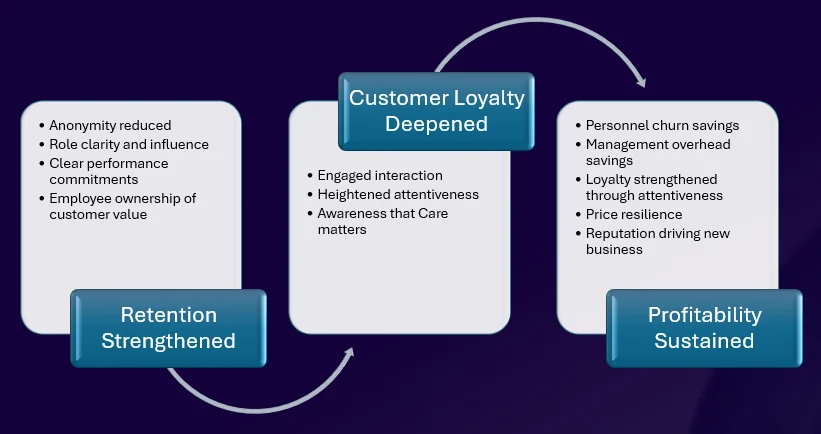
Many organisations treat staff engagement, customer loyalty, and profitability as separate challenges. They run initiatives for each, often in different silos, and are surprised when results fall short. Yet the truth is simple: these outcomes are deeply connected. A culture that strengthens retention naturally deepens customer loyalty, and in turn sustains profitability. The flow is not abstract. It is measurable, visible, and repeatable.
This connection is best seen as a chain reaction. If you invest deliberately in your people, they invest in your customers. When customers feel cared for, they respond with loyalty. That loyalty, in turn, stabilises and strengthens the business model. Service culture is not an add-on. It is the operating system of a healthy business.
Retention Strengthened
Excellence begins inside the organisation. Employees who feel seen, supported, and trusted bring more energy and attentiveness to their work. When anonymity is reduced and roles are clarified, people know they matter and how they make a difference. Clear performance commitments provide a sense of ownership, and when staff take responsibility for customer value, they act with greater care.
The benefits of retention are immediate and long-term. Reduced turnover cuts recruitment costs and reduces the disruption caused by constant onboarding. Experienced staff understand not only the tasks but also the context and culture, which means fewer errors and smoother collaboration. A culture of ownership means tasks are handled proactively rather than passed along or avoided. Most importantly, employees stay longer and form deeper relationships with colleagues and customers, giving service consistency and a human touch that cannot be replicated by process alone.
Retention also strengthens resilience. In times of change or stress, organisations with high tenure and engaged teams recover faster because trust and shared experience provide stability. Customers notice this, and in uncertain markets, they gravitate toward stability.
Customer Loyalty Deepened
Engaged employees create engaged customers. When staff are attentive, customers feel recognised and valued. Heightened attentiveness communicates care, and customers instinctively trust organisations that demonstrate it. Awareness that “care matters” is contagious. Employees who feel cared for pass it on. Customers who feel cared for return, recommend, and spend more.
This loyalty is not just sentimental. It has a direct commercial impact. Research shows that customers who feel emotionally connected to a brand have significantly higher lifetime value than those who are merely satisfied. They buy more often, are less price-sensitive, and serve as informal ambassadors.
Loyalty also cushions against mistakes. In a low-trust relationship, a single error can end the partnership. In a high-trust relationship, customers are more forgiving. They interpret errors as exceptions, not patterns. This flexibility allows organisations to recover faster and maintain stability even when problems arise.
Deepened loyalty also drives differentiation. In industries where products and services are increasingly commoditised, experience is often the only distinguishing factor. Two companies may offer the same product at similar prices, but customers choose the one that makes them feel valued. In competitive environments, that margin of loyalty can be decisive.
Profitability Sustained
The compounding effect of retention and loyalty is profitability. With reduced churn, personnel costs stabilise. With stronger loyalty, management overhead declines because less time is spent firefighting issues. With attentiveness embedded, customers choose to stay even when competitors push for their attention.
Profitability sustained by loyalty is more stable than profitability sustained by constant acquisition. Acquisition is expensive. Retention is efficient. The economics are simple: it costs significantly less to retain a customer than to acquire a new one, and loyal customers often spend more over time. By sustaining loyalty, organisations create a compounding effect on margins.
This creates resilience. Prices can hold because value is clear. Reputation becomes a growth engine, drawing new business through referrals and word of mouth. The organisation is not trapped in a cycle of discounting to attract or retain customers. Instead, it builds a foundation for long-term profitability.
Importantly, profitability sustained by culture is more resistant to external shocks. In downturns, customers often cut back, but they cut back least on the providers they trust most. Employees, too, are less likely to jump when markets are unstable if they feel rooted in a culture of care. This combination gives the organisation resilience that is hard to replicate through tactics alone.
Practical Levers for Leaders
To unlock this chain reaction, leaders must act deliberately. It does not happen by chance. Five levers make the biggest difference:
- Role clarity and influence. Ensure employees understand not only their responsibilities but also their authority. Ambiguity breeds hesitation. Clarity breeds confidence.
- Performance commitments. Define clear, measurable commitments that connect individual roles to customer value. People need to see the link between their effort and the customer outcome.
- Ownership culture. Shift language from tasks to outcomes. Employees should feel that they own the customer experience, not just their checklist.
- Recognition and storytelling. Capture and share moments of attentiveness. Stories multiply faster than policies and show what culture looks like in practice.
- Leadership consistency. Ensure leaders model the behaviours they expect. Inconsistency at the top undermines everything else.
The BIAMIC Perspective
This flow from retention to loyalty to profitability is central to the Moments that Matter philosophy. It shows why culture and attentiveness are not optional extras but core business levers. When leaders invest in strengthening the internal environment, the benefits cascade. Employees stay, customers stay, and profitability follows.
The philosophy is simple: what you do for your people is what your people do for your customers, and what your customers do for your business. Retention builds loyalty. Loyalty builds resilience. Resilience sustains profitability.
At BIAMIC, we guide organisations through this journey. Our workshops and frameworks equip leaders to architect environments where attentiveness is natural, ownership is expected, and care is consistent. By shaping the in-between – the quiet, daily practices that often go unnoticed – organisations unlock the compounding effect that turns culture into profit.
Service excellence is not a one-off act. It is a chain reaction. The organisations that thrive are those that invest in the first link: strengthening retention. From there, loyalty and profitability follow.
Make a booking to chat about how this could best serve you.