
Service Excellence and the Underdog Advantage
How limitations become catalysts for lasting impact
The story of David and Goliath is more than an ancient tale of victory against the odds. Malcolm Gladwell’s David and Goliath shows us that perceived disadvantages can become powerful strengths. What looked like David’s weakness – his youth, size, and lack of armour – was precisely what gave him the agility and courage to win.
This principle matters deeply for service culture. Organisations often think they need bigger budgets, more staff, or cutting-edge systems to deliver excellence. But the truth is that constraints, when reframed, often create the very conditions that allow service brilliance to shine.
The underdog advantage is not about pretending challenges don’t exist. It is about seeing how disadvantages can be turned into distinct strengths. In service contexts, this perspective can transform teams, inspire creativity, and create moments that matter.
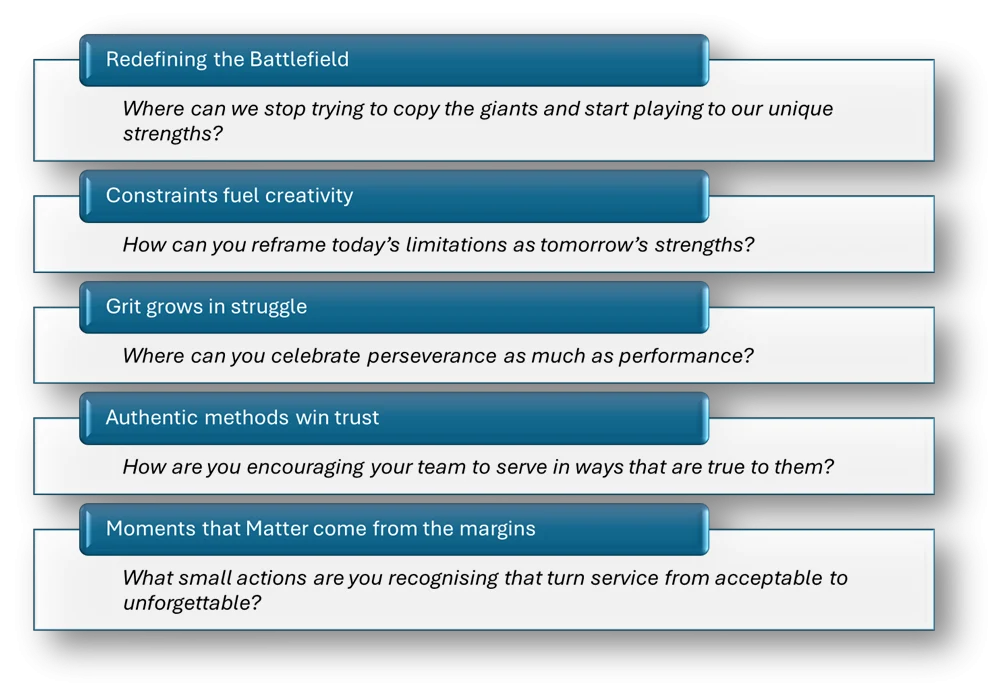
1. Redefining the battlefield
David won because he refused to play by Goliath’s rules. Instead of engaging in close combat, he used his skill with a sling, fighting from a distance on his own terms.
In service organisations, the same principle applies. Smaller teams cannot always compete with large corporations on volume or resources. But they can redefine the battlefield by focusing on agility, personalisation, and authenticity. A boutique hotel cannot match the scale of a global chain, but it can deliver a level of warmth and personal connection that guests remember.
The question for leaders is simple: where can we stop trying to copy the giants and start playing to our unique strengths?
2. Constraints fuel creativity
Underdog teams are often forced to innovate because they cannot rely on abundance. Lack of budget may lead to more imaginative solutions. Limited staff may drive cross-training that increases flexibility.
Consider a service desk that lacks advanced automation. Instead of seeing it as a disadvantage, the team may use it to develop deeper listening skills, personal follow-up routines, and stronger human rapport. Customers may actually value this attentiveness more than the speed of a scripted bot.
Constraints, when embraced, drive the creativity that sets organisations apart.
The question for leaders is: how can you reframe today’s limitations as tomorrow’s strengths?
3. Grit grows in struggle
Underdogs learn perseverance because they must. Adversity creates resilience. Gladwell points out that many great achievers came from difficult circumstances. Their grit, forged in struggle, became their competitive advantage.
In service culture, teams that face tough conditions often build greater adaptability. They know how to stay calm under pressure, how to improvise when systems fail, and how to recover when things go wrong. Customers notice this resilience. They experience not perfection, but determination – and that builds trust.
The principle is clear: adversity, handled well, does not weaken service culture. It strengthens it.
The question for leaders is: where can you celebrate perseverance as much as performance?
4. Authentic methods win trust
David could not wear Saul’s armour. It was too heavy, too ill-fitting, too unfamiliar. He had to be himself.
In organisations, trust is earned when teams use methods authentic to them. Customers sense when service is forced or scripted. They also sense when it is genuine. The underdog advantage is that smaller or constrained teams often have no choice but to rely on authenticity. They do not have the gloss of a giant. They only have their humanity.
And it is precisely that humanity that customers crave.
The question for leaders is: how are you encouraging your team to serve in ways that are true to them?
5. Moments that Matter come from the margins
The most memorable service moments often arise from teams operating in the margins – making the extra effort, personalising the detail, going off-script to add value. These do not require vast resources. They require attentiveness.
A waiter remembering a regular’s favourite drink. A technician checking in after an installation to see if everything still works. A manager sending a personal note of thanks. These are not costly. They are intentional.
The underdog advantage is that teams that cannot rely on overwhelming resources often rely instead on attentiveness. That attentiveness creates the Moments that Matter, which distinguish organisations in the hearts of customers.
The question for leaders is: what small actions are you recognising that turn service from acceptable to unforgettable?
Linking with Outliers: skill, opportunity, and effort
The underdog advantage echoes Gladwell’s other great insight from Outliers: that extraordinary success arises from the convergence of three things – skill mastery, opportunity, and significant effort.
- Skill: David had mastered the sling through countless hours of practice. Underdog organisations must also cultivate deep skills. It becomes the equaliser against larger competitors.
- Opportunity: David seized a moment others overlooked, reframing the fight. Service teams must also notice opportunities – a complaint that can become loyalty, or a small moment that can become unforgettable.
- Effort: Victory still required courage and execution. Service cultures thrive when teams apply effort consistently, even when no one is watching.
When skill, opportunity, and effort converge, the underdog advantage is realised. It is not luck. It is preparation, meeting the right moment with courage.
Leadership implications
Leaders play a critical role in turning disadvantages into strengths. They must:
- Frame constraints as catalysts: Shift the narrative from “we cannot” to “what could this make possible?”
- Encourage authenticity: Give staff permission to be human rather than scripted.
- Celebrate small wins: Highlight examples where attentiveness, grit, and creativity made the difference.
- Develop skill deliberately: Ensure teams practise and refine their craft so that when opportunities come, they are ready.
- Sustain effort: Build rhythms that make perseverance possible without creating burnout.
Leadership is where the underdog advantage either flourishes or fades. Without leaders who see potential in constraints, teams default to frustration. With such leaders, teams discover strength they did not know they had.
The BIAMIC perspective
At BIAMIC, we believe service excellence is not about overwhelming resources, but about purposeful choices. Moments that Matter are created not in abundance, but in attentiveness. The underdog advantage shows that constraints, reframed, are not weaknesses. They are the soil in which creativity, grit, and authenticity grow.
In a competitive world, giants will always exist. But customers do not always choose the biggest. They choose the organisations that notice them, value them, and care for them. That is the underdog advantage.
Make a booking to chat about how this could best serve you.