
More Than A Moment
Deeper Principles from Excellence Wins by Horst Schulze
Horst Schulze’s Excellence Wins is widely known for its clarity around what customers need: a product without defect, delivered on time, with genuine care. But Schulze’s deeper legacy lies in the values, systems, and leadership philosophies that support service excellence over the long term.
The following principles expand Schulze’s foundational insights, offering timeless lessons for leaders and teams aiming to build a culture where excellence is not an act – but a habit.
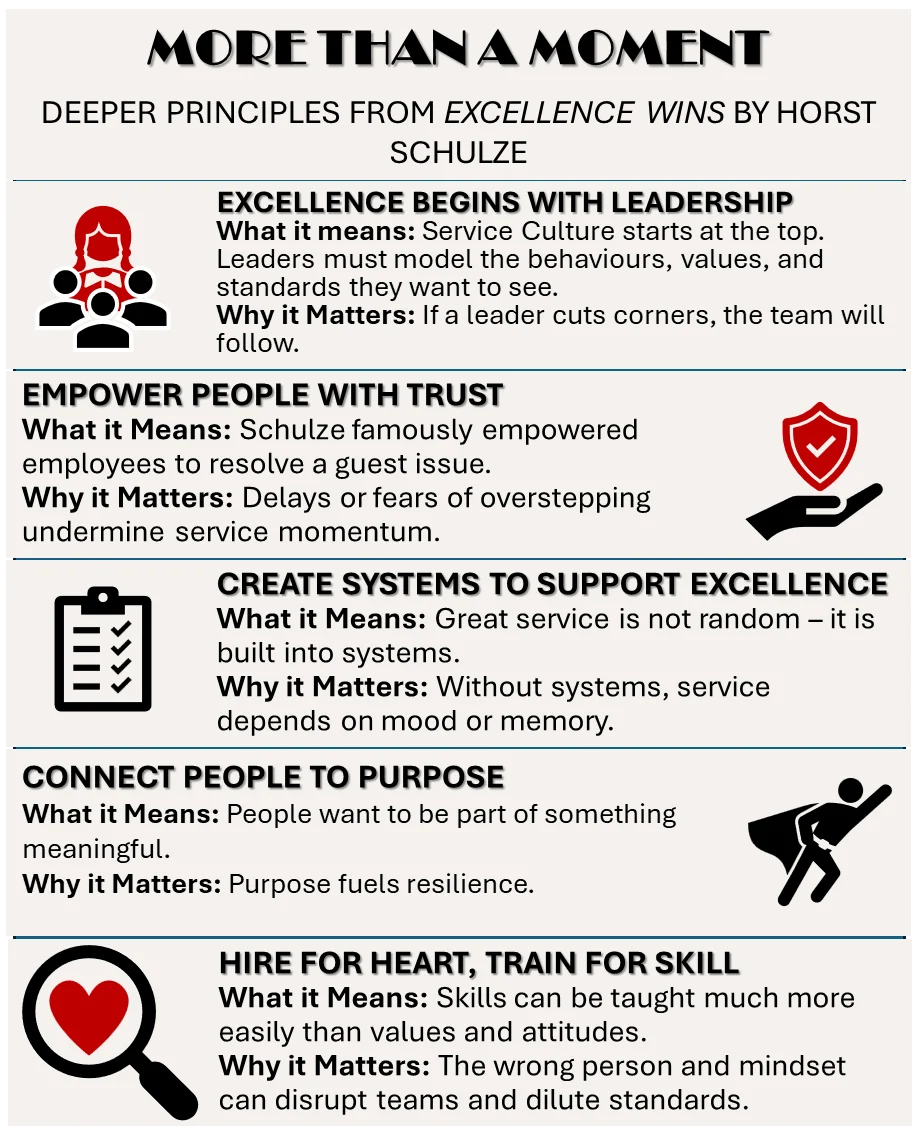
1. Excellence Begins with Leadership
What it means: Service culture starts at the top. Leaders must do more than issue directives – they must model the behaviours, values, and standards they want to see. Excellence flows from example.
Why it matters: If a leader cuts corners or ignores values, the team will follow. But when a leader walks with integrity, others rise to meet that standard.
Application:
- Leaders must be consistent in tone, messaging, and action.
- Coaching and development should be prioritised, not delegated.
- Team members mirror what they see – clarity and alignment begin with leadership.
2. Empower People with Trust
What it means: Schulze famously empowered every Ritz-Carlton employee to spend up to $2,000 to resolve a guest issue. The point wasn’t the money – it was about trust. When people are treated as professionals, they rise to the occasion.
Why it matters: Delays in decision-making or fear of overstepping undermine service momentum. Empowered employees respond faster, personalise more, and own outcomes.
Application:
- Establish clear boundaries, then give autonomy within them.
- Remove approval chains that disempower people.
- Train and trust employees to act in the best interest of the customer.
3. Create Systems to Support Excellence
What it means: Great service is not random – it is built into systems. Consistency doesn’t come from memory or enthusiasm, but from structured, repeatable habits.
Why it matters: Without systems, service depends on the mood or memory of the person delivering it. That’s risky and unsustainable.
Application:
- Design checklists, standards, and service rituals.
- Use metrics and feedback loops to improve continuously.
- Balance structure with space for personalised moments.
4. Connect People to Purpose
What it means: People don’t want to just fulfil tasks – they want to be part of something meaningful. When employees understand how their work matters, they bring heart to what they do.
Why it matters: Purpose fuels resilience and pride. People who feel connected to their organisation’s mission serve with more joy and consistency.
Application:
- Regularly reinforce the impact of each role on the customer’s life.
- Share stories of meaningful service moments.
- Help each person see themselves as a contributor to a larger vision.
5. Hire for Heart, Train for Skill
What it means: Skills can be taught – values and attitude are much harder to shape. Schulze believed in hiring people who already had a service mindset, then giving them the tools to succeed.
Why it matters: The wrong cultural fit disrupts teams and dilutes standards. People who care naturally go the extra mile.
Application:
- Make values-based hiring the norm.
- Ask interview questions that explore empathy, initiative, and teamwork.
- Use onboarding to embed service philosophy from day one.
In Practice with BIAMIC
These principles are foundational to BIAMIC’s approach. Whether through coaching, cultural assessment, or the BIAMIC Navigator™, the focus is not only on delivering excellence – but on creating environments where excellence can thrive naturally, every day.
When these ideas are lived, service stops being a function. It becomes part of the organisation’s identity.
Make a booking to chat about how this could best serve you.