
Never Split The Difference – Service that Negotiates with Empathy
Insights from Chris Voss’s ‘Never Split the Difference‘
Chris Voss’s landmark book on negotiation isn’t just for high-stakes hostage situations – it’s a masterclass in communication, empathy, and influence. When viewed through the lens of service excellence and culture building, it offers profound guidance on how teams and leaders can engage with others more thoughtfully and more effectively.
In a world where frontline service interactions are often tense, rushed, or misunderstood, Never Split the Difference reminds us that how we speak and listen matters deeply.
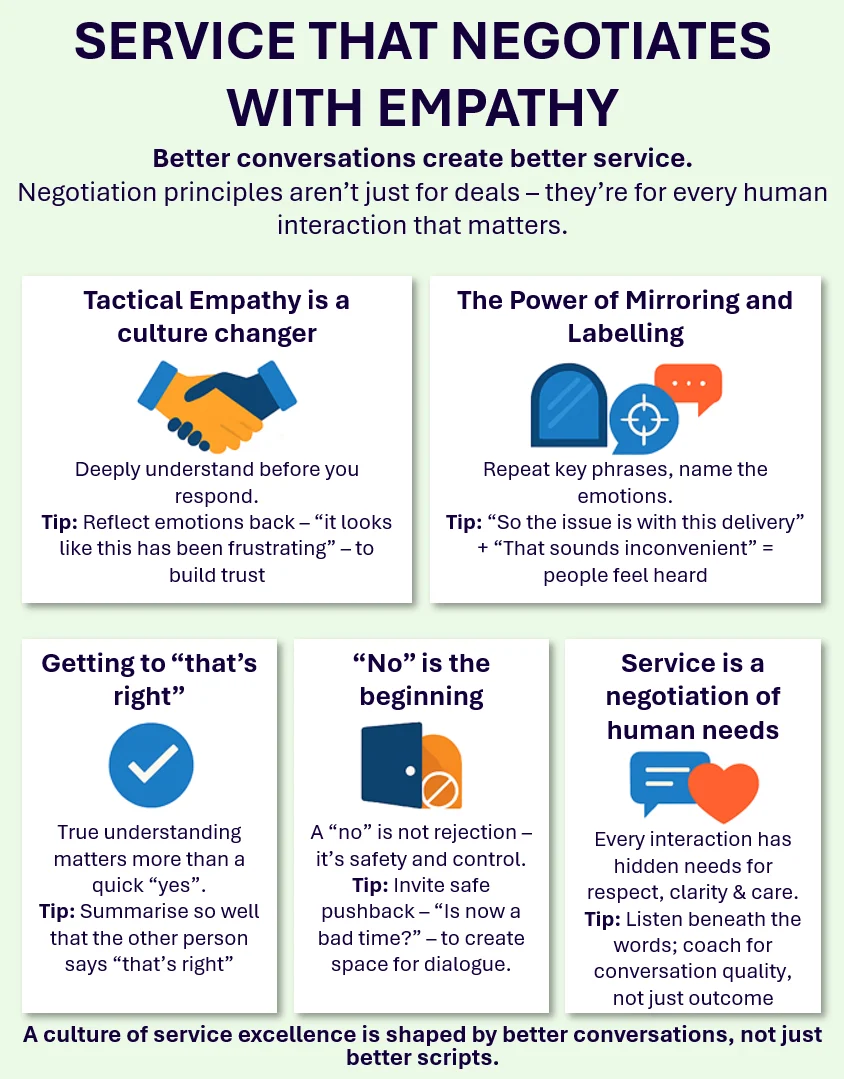
1. Tactical Empathy is a Culture-Changer
Voss introduces the idea of tactical empathy – the practice of deeply understanding someone’s perspective and using that insight to guide your response. It’s not agreement; it’s alignment through understanding.
Application: In service interactions, taking the time to reflect a customer’s emotions back to them changes the tone of the engagement. “It sounds like this has been frustrating” is not just a polite statement – it’s a trust-building move.
2. The Power of Mirroring and Labelling
Repeating key phrases (mirroring) and naming emotions (labelling) are simple but effective tools to create connection and open up dialogue.
Application: Service teams that mirror a client’s concern (“So the issue is with the delivery time?”) and label the emotion (“That sounds really inconvenient”) are more likely to turn tense situations into collaborative ones. These practices make people feel heard.
3. Getting to ‘That’s Right’
Voss distinguishes between getting a “yes” and getting to “that’s right.” The latter signals true understanding.
Application: In service recovery, summarising the client’s pain point so clearly that they say, “That’s right,” marks a turning point. It confirms that trust is being rebuilt. Aim for that – not rushed resolution.
4. “No” is Not the End – It’s the Beginning
People feel safer when they can say “no.” It gives them a sense of control.
Application: In leadership and team communication, invite healthy pushback. In service settings, honouring a client’s initial hesitation can lead to deeper engagement and better outcomes. “Is now a bad time?” creates space, not resistance.
5. Service is a Negotiation of Human Needs
Every service interaction involves unspoken needs – for respect, efficiency, clarity, and care. Approaching service like a conversation to uncover those needs makes delivery more meaningful.
Application: Equip service teams to listen beneath the words. Encourage leaders to coach for conversation quality, not just outcomes. Let empathy drive decision-making.
Shaping Service Culture Through Dialogue
The principles in Never Split the Difference are not tricks – they are tools of respect. At BIAMIC, the goal is not to win interactions, but to transform them. Trust is earned, not demanded. And it grows in environments where people feel understood.
A culture of service excellence isn’t built by better scripts – it’s shaped by better conversations.
Make a booking to chat about how this could best serve you.