
Success in Context
Skills, Opportunity, and Effort in Outliers by Malcolm Gladwell
Malcolm Gladwell’s Outliers challenges the tidy idea that success is just about raw talent or individual determination. Instead, Gladwell shows that extraordinary success is born when three ingredients combine: skill mastery, opportunity, and significant effort.
Each of these is powerful on its own. Together, they are transformative. Outliers are not just the result of brilliance or luck. They are the product of environments that nurture skill, open doors to opportunity, and require relentless effort.
This is not only true for world-class musicians, entrepreneurs, or athletes. It also applies in the workplace, in leadership, and in service cultures. The conditions that create “outliers” in society are the same ones that can elevate ordinary organisations into places where excellence becomes the norm.
1. Skill: The Foundation of Mastery
Skill is the starting point. It represents competence developed through deliberate practice, feedback, and refinement. Gladwell’s research made famous the “10,000-hour rule” – not as a magic number, but as a way to illustrate the volume of practice required to achieve mastery.
In service culture, skill looks like technical ability paired with relational capability. A call centre agent needs both system fluency and conversational tact. A hospitality manager needs both operational sharpness and the capacity to read a guest’s mood. Without skill, even the best opportunities are wasted.
How skill grows:
- Create environments where deliberate practice is the norm, not the exception.
- Provide feedback loops that build confidence and competence.
- Recognise and reward the pursuit of mastery, not just quick results.
At BIAMIC, we view skill-building as a continuous process. It is not about one-time training. It is about systems that ensure feedback is constant and growth is visible.
2. Opportunity: The Doorway to Application
Skill without opportunity remains hidden. Gladwell’s famous examples – Bill Gates’ unusual access to a computer lab as a teenager, or Canadian hockey players benefiting from age cut-offs – reveal how external structures shape success.
In organisations, opportunity takes many forms:
- Access to projects where skills can be stretched.
- Visibility to decision-makers.
- A culture that welcomes contributions from all levels, not just the loudest voices.
Without opportunity, high-potential individuals stagnate. Their skills are invisible. Their motivation fades. By contrast, when doors are opened, people surprise even themselves with what they are capable of.
How opportunity is created:
- Make progression pathways visible, not hidden.
- Invite contributions from diverse voices and overlooked strengths.
- Design systems that reward readiness and initiative, not just hierarchy or tenure.
In BIAMIC’s work, opportunity is one of the most critical levers. Teams flourish when they believe there is space for their contribution to matter. Leaders flourish when they shift from gatekeeping to enabling.
3. Effort: The Multiplier of Success
Effort is where potential becomes reality. Gladwell reminds us that talent plus opportunity still requires perseverance. Without effort, even the most gifted people fall short. With effort, ordinary individuals achieve extraordinary outcomes.
In service excellence, effort is visible in attentiveness. It is the choice to notice the detail others miss, to follow through when it is inconvenient, to stay with a challenge until it is resolved. Effort is what customers remember – not the system behind the service, but the persistence of the person in front of them.
How effort is sustained:
- Celebrate progress, not only peak performance.
- Build cultures where consistent contribution is recognised.
- Share stories of perseverance that inspire resilience.
Effort cannot be commanded, but it can be cultivated. Purpose, recognition, and accountability are the soil in which sustained effort grows.
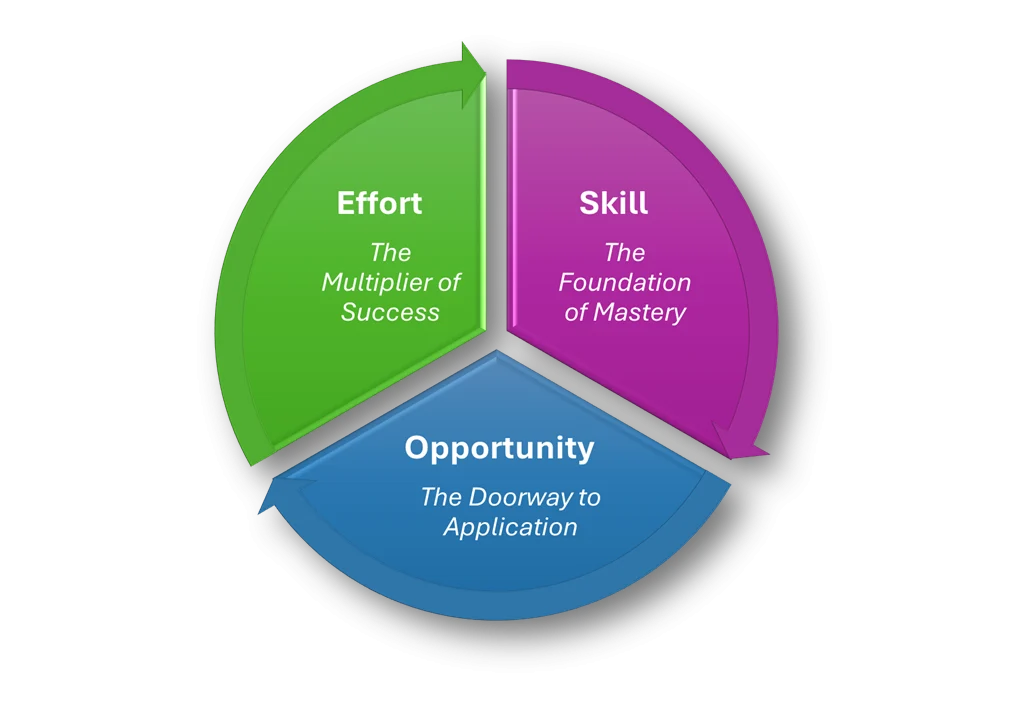
Why All Three Must Be Present
The real lesson from Outliers is not that each element matters in isolation, but that the extraordinary emerges only when all three overlap.
- Skill without opportunity is wasted. Think of a brilliant musician without access to an instrument.
- Opportunity without skill creates frustration. A door may open, but without competence, the moment is lost.
- Skill and opportunity without effort produce potential that never becomes progress.
Gladwell’s outliers all had the three elements at once. They developed skills through deliberate practice. They encountered unique opportunities that allowed those skills to shine. And they invested enormous effort, often invisible to others, to reach mastery.
The same is true in service culture. An organisation that builds skills but provides no opportunities suffocates talent. An organisation that creates opportunities but tolerates low standards of effort breeds disappointment. An organisation that demands effort but neglects skill or opportunity burns people out.
Excellence requires balance.
A Coaching Reflection
For leaders, this framework reframes how performance is evaluated. Instead of asking only, “Why isn’t this person delivering?”, the better question is:
- Do they have the skill they need?
- Have we created opportunities for them to apply it?
- Are they putting in the effort required – and are we making that effort sustainable?
At BIAMIC, we embed these questions into our coaching and consulting engagements:
- Skill is nurtured through clarity, feedback, and encouragement.
- Opportunity is unlocked through inclusion, visibility, and alignment.
- Effort is cultivated through purpose, recognition, and accountability.
When all three are present, excellence becomes less about chance and more about certainty. Success stops being accidental. It becomes inevitable.
The BIAMIC Perspective
The story of outliers is not just about individuals who achieved greatness. It is about systems and cultures that either enable or block success. Every team has hidden outliers waiting to be revealed. Every organisation has the choice to build an environment where skill, opportunity, and effort converge.
Moments that Matter are born in this convergence. A customer remembers when skill was applied seamlessly, when opportunity was taken to personalise the moment, and when effort made the difference between acceptable and memorable.
Service excellence is not about shortcuts. It is about creating conditions where people can master their craft, seize their opportunities, and bring consistent effort. That is where outliers come from – and that is where culture transforms.
Make a booking to chat about how this could best serve you.