
The BIAMIC Offering for Service Culture
Turning service culture from insight into action
Every organisation reaches a crossroads. Leaders see the signs: staff engagement slipping, customer loyalty weakening, or profitability under pressure. Teams feel it too. They sense that the culture could be stronger, that service could be sharper, and that moments of care could happen more often. Reflection is important, but there comes a point where the question is unavoidable: where to from here?
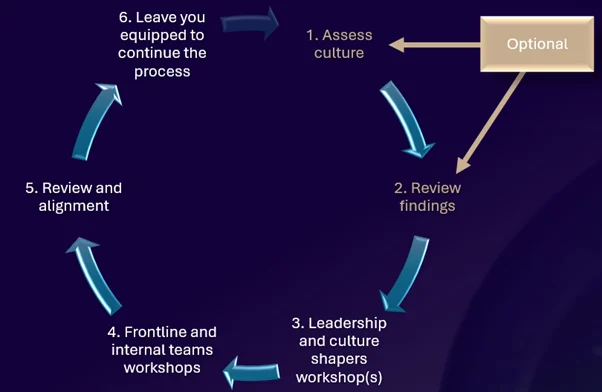
Change does not happen by accident. It requires deliberate steps, designed to translate insight into action and action into sustainable culture. The BIAMIC pathway offers exactly this — a structured but flexible process that begins with clarity, builds momentum, and ends with empowerment.
Step 1: Assess the culture
The first step is to look honestly at where the organisation stands today. Leaders often have a sense of the culture, but without assessment, that sense is incomplete. Employees may experience the culture very differently from what leaders imagine. Customers may see patterns that internal teams overlook.
Assessment provides the foundation for all that follows. It captures both data and stories, shining a light on the in-between moments that matter most. It reveals the strengths to build on and the barriers to address. This is not about judging, but about seeing clearly. A culture cannot be shaped until it is understood.
Step 2: Review the findings
Findings matter only if they are interpreted well. Data points alone do not tell a story. Review sessions bring leaders together to ask the right questions. Where are the points of friction. Where are the bright spots that can be multiplied. Which systems support attentiveness, and which silently undermine it.
This stage is about alignment. Leaders who engage deeply with the findings move beyond surface issues and into the drivers of behaviour. They begin to see how daily experiences connect to larger outcomes, and why service excellence is not a project but a culture.
Step 3: Leadership and culture shapers workshop
No change holds without leadership alignment. Leaders and key influencers shape the tone of an organisation more than any document or slogan ever can. This workshop focuses on three essentials: alignment, ownership, and modelling.
Leaders learn how to architect the environment rather than attempt to control people. They explore the balance of the system of the soul and the soul of the system — designing structures that enable attentiveness while bringing humanity into process. They examine how their own actions, words, and recognition choices send louder signals than any policy.
By the end of this stage, leaders do not simply endorse the change. They own it. They are equipped to model it in ways that employees notice and trust.
Step 4: Frontline and internal teams workshops
Culture becomes real when it reaches the frontline. Employees are the ones who create the daily moments that shape customer perception. These workshops are designed to show staff that they are not passive executors of tasks, but active creators of moments that matter.
Teams learn practical tools for attentiveness, ownership, and storytelling. They see how their individual roles connect directly to the organisation’s purpose. They are encouraged to take pride in small acts that accumulate into legendary service.
This step also strengthens psychological safety. When people feel safe to speak up, suggest improvements, and share stories, the culture shifts from compliance to commitment. Service excellence becomes personal.
Step 5: Review and alignment
Transformation is not linear. After the initial workshops, organisations pause to review. This stage checks whether insights have been embedded and whether behaviours are shifting. Successes are celebrated and multiplied. Gaps are identified and addressed.
This is a moment for recalibration, ensuring that the energy created in the earlier steps does not dissipate. Leaders and teams realign on commitments, reinforcing trust that the journey is not just a campaign but a long-term shift. Without this stage, momentum can fade. With it, progress is reinforced and accelerated.
Step 6: Equipped to continue
The final step is empowerment. The goal of BIAMIC is not to create dependency but to leave organisations equipped to sustain change themselves. Tools, frameworks, and rhythms are embedded into daily practice. Leaders and teams know how to capture and share stories, how to keep alignment fresh, and how to measure what matters.
At this point, excellence is no longer a project. It is a way of working. Service culture is not fragile or dependent on external intervention. It is internalised, sustained, and growing.
Optional: Flexible entry points
Not every organisation starts from the same place. Some begin with assessment. Others are already clear on culture challenges and choose to move straight into workshops. The BIAMIC pathway is adaptable. What matters is not where you enter, but that you follow the steps with intent.
The optional entry point ensures that organisations can engage at a pace and scale that suits them. Whether starting with a full diagnostic or diving into leadership alignment, the principle remains constant: culture must be addressed deliberately, with both system and soul.
Why this process matters
Many organisations fall into the trap of believing that culture shifts can be achieved through communication campaigns or one-off initiatives. Posters, slogans, and values statements may create awareness, but they do not change behaviour. What changes behaviour is structure combined with story, clarity combined with care, and leadership combined with frontline ownership.
The BIAMIC pathway provides this balance. It ensures that insight does not stop at reflection, but moves into action. It creates alignment from the boardroom to the frontline. It equips organisations not only to make progress, but to sustain it.
The BIAMIC Perspective
“Where to from here” is not simply a rhetorical question. It is the invitation to move from acknowledgement to transformation. The journey is structured, but it is also deeply human. Each step addresses both the practical systems and the emotional drivers that shape culture.
At BIAMIC, we believe that service excellence is not an initiative, but a discipline. It is sustained through intentional choices, reinforced by systems, and brought to life through people. The pathway we offer is designed to leave organisations not only improved, but also empowered.
Where you go from here will determine whether service remains a concept or becomes a culture. The choice is yours, and the opportunity is now.
Make a booking to chat about how this could best serve you.