
The Five Dysfunctions of a Team
Patrick Lencioni‘s Framework for Building Trust and Performance :
Even the most talented teams can struggle to work well together. Why? Because teamwork is not a default setting – it’s a discipline. Patrick Lencioni’s The Five Dysfunctions of a Team outlines a powerful model for understanding and overcoming the internal barriers that undermine trust, alignment, and accountability.
This framework has become foundational in leadership and culture work because it speaks directly to the root causes of team underperformance – not just the symptoms.
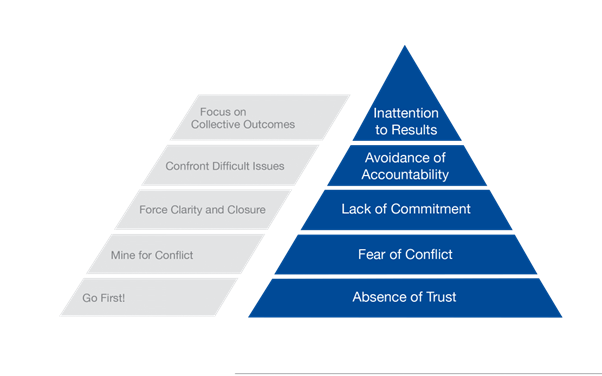
The Five Dysfunctions
1. Absence of Trust
What it looks like: Team members conceal weaknesses, avoid vulnerability, and hesitate to ask for help. They fear being judged rather than feeling safe to be open.
Why it matters: Trust is the foundation of all effective teamwork. Without it, honest dialogue, constructive feedback, and mutual support are impossible.
How to address it: Create space for vulnerability-based trust. This begins with leaders modelling openness, admitting mistakes, and showing they don’t have all the answers. Trust grows through shared experience, empathy, and consistent follow-through.
2. Fear of Conflict
What it looks like: Teams avoid difficult conversations, nod along without raising concerns, or allow tension to simmer under the surface.
Why it matters: Healthy conflict is necessary for growth. It allows issues to be surfaced, ideas to be tested, and decisions to be made with clarity.
How to address it: Normalise constructive conflict. Encourage teams to challenge respectfully and debate ideas without making it personal. Framing conflict as a form of commitment – not confrontation – helps build strength through disagreement.
3. Lack of Commitment
What it looks like: Decisions are vague, alignment is unclear, and people hesitate to fully buy in. Meetings end without clear direction, and follow-through is inconsistent.
Why it matters: Without clarity and buy-in, even the best strategies fail. Teams waste energy second-guessing or resisting decisions.
How to address it: Drive clarity through explicit decision-making and documented outcomes. Invite input, but ensure every voice understands the final call. Commitment comes when people feel heard – even if their view doesn’t prevail.
4. Avoidance of Accountability
What it looks like: Poor performance goes unaddressed, team norms are ignored, and people hesitate to call out peers on missed commitments.
Why it matters: Accountability is not just a leader’s role – it’s a team responsibility. Without it, trust and performance both decline.
How to address it: Create peer-to-peer accountability. Help teams agree on standards and regularly review their own performance. Accountability becomes cultural when it is shared, consistent, and valued.
5. Inattention to Results
What it looks like: Team members prioritise personal success, departmental goals, or status over collective outcomes.
Why it matters: When the team isn’t focused on shared success, collaboration erodes. Silos re-emerge, and politics take the place of purpose.
How to address it: Make results visible, measurable, and meaningful. Celebrate team wins, not just individual accomplishments. Reconnect everyone to the shared mission – especially when the pressure rises.
Applying the Model with BIAMIC
These five dysfunctions mirror many of the cultural and leadership challenges addressed through BIAMIC’s coaching, workshops, and Navigator™ platform. Whether rebuilding a struggling team or strengthening one that’s already performing, Lencioni’s model offers a clear, actionable path.
By focusing on trust, healthy conflict, commitment, accountability, and results, teams not only perform better – they feel better. That’s the mark of a healthy, service-driven culture.
Curious how this framework could strengthen your team? Let’s explore how to turn dysfunction into momentum.
Make a booking to chat about how this could best serve you.