
Little Things, Lasting Impressions
Why the Smallest Gestures Make the Greatest Impact
When we think of excellence in service, it is tempting to imagine grand gestures, sweeping innovations, or game-changing strategies. Yet in practice, the most powerful impressions are often made in the smallest moments. A name remembered. A coffee brought without being asked. A handwritten note slipped into a parcel.
These actions rarely cost much, nor do they always appear in standard operating procedures. Yet they are the things people remember, the things they retell, and the things that form the emotional fabric of culture. They are what we at BIAMIC call Moments that Matter.
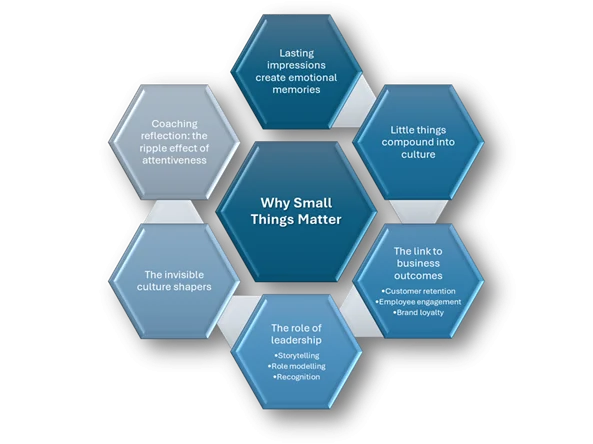
Why small things matter
Customers expect the basics: competence, timeliness, and products free from defect. These are non-negotiables, and failing in them creates frustration. But meeting the basics does not create loyalty. Loyalty is built in the space above expectation, where the human touch is added.
The principle is simple: the smallest details often leave the largest impressions. Think of the hotel porter who remembers a guest’s preferred newspaper, or the call centre agent who notices the stress in a client’s voice and slows their pace. Neither is extraordinary on its own. But in the moment, they communicate care, attentiveness, and respect.
1. Lasting impressions create emotional memory
Psychologists tell us that people rarely remember every detail of an experience. What they carry with them is how they felt. Service moments are no different. The details fade, but the emotion lingers.
Small gestures create emotional anchors. A receptionist who notices a client’s nervousness and reassures them, a cashier who compliments a child’s toy, or a nurse who explains an instruction slowly rather than rushing on – these micro-moments create feelings of trust, warmth, and belonging.
Organisations that build these impressions into their culture don’t just deliver transactions. They create memories.
2. Little things compound into culture
It is easy to dismiss small gestures as insignificant. But culture is built not in slogans but in repeated behaviours. When dozens of employees choose to notice, respond, and care in the little things, culture becomes tangible.
A simple “good morning” exchanged consistently can shift the mood of an entire team. Small recognitions of effort – a word of thanks, a nod in a meeting, a note left on a desk – reinforce the message that people are seen and valued. Over time, these accumulate into trust.
This is where the tension with SOPs becomes clear. Standard operating procedures keep organisations efficient, but they cannot fully script attentiveness. Leaders who allow space for humanity alongside procedure enable cultures where people feel empowered to make those “off-script” gestures that matter most.
3. The link to business outcomes
There is a misconception that focusing on the little things is “soft” – nice to have but not essential. In reality, these gestures are strategic. They have measurable impact.
- Customer retention: Customers who feel cared for return more often and refer others.
- Employee engagement: Staff who see care modelled and practised experience higher morale and stronger loyalty.
- Brand loyalty: Organisations known for care in the details stand out in markets crowded with competence but lacking in warmth.
The small things, repeated consistently, compound into tangible business results.
4. The role of leadership
Small things flourish or fade depending on leadership. Leaders set the conditions for whether attentiveness is celebrated or ignored. They do this in three ways:
- Storytelling
Leaders can capture and share stories of small gestures that made a difference. These stories spread faster than policies and become cultural markers. - Role-modelling
Leaders who practise attentiveness in their own interactions – greeting by name, following up, showing genuine interest – signal to staff that this is valued. - Recognition
When leaders highlight and reward small gestures, they legitimise them. Recognition tells staff that noticing and caring is not just “nice,” it is expected.
Without leadership reinforcement, small things remain isolated acts. With reinforcement, they become cultural habits.
5. The invisible culture-shapers
Culture is not built in the boardroom. It is built in corridors, at front desks, in email replies, and in side conversations. The invisible shapers of culture are the actions taken when no one is watching.
- Do staff greet each other in the morning?
- Do leaders acknowledge extra effort even when results are not yet visible?
- Do colleagues share credit or hoard it?
These behaviours are subtle, but they define the atmosphere. Customers feel it immediately, even if they cannot name it. Visitors can sense whether an organisation is warm or cold, collaborative or competitive, attentive or indifferent. The invisible becomes visible through the little things.
6. Coaching reflection: the ripple effect of attentiveness
For leaders and teams, the challenge is to see the ripple effect of the small. Each time you choose attentiveness, you plant a seed. Each time you notice, respond, or follow through, you create a story that will be retold.
At BIAMIC, we encourage leaders to ask: What small gesture can you practise this week that will leave a lasting impression?
It might take two minutes to handwrite a thank-you note. It might be asking a team member how their family is doing, and listening carefully. It might be adding a personal touch to a customer email. These are small investments, but their return is disproportionate.
The BIAMIC perspective
We believe service excellence is built on the daily discipline of small gestures. Systems provide scaffolding, but it is the little things that humanise the experience. They turn competence into care, and transactions into relationships.
Moments that Matter are rarely scripted. They are found in the pauses, the details, the unexpected touches that show people they are valued. They may not make headlines, but they create cultures that last.
The truth is simple: little things are not little. They are the building blocks of service excellence.Want to help your team build unforgettable service through small, daily choices? Let’s design those moments together.
Make a booking to chat about how this could best serve you.