
Rediscovering the Fire – The Founder’s Mentality and Service Excellence
Inspired by Chris Zook and James Allen’s ‘The Founder’s Mentality‘
Every organisation begins with a spark – a mission to change something, serve someone, or solve a problem. Over time, as systems grow and structures solidify, that spark often dims. The energy that once animated bold decisions and relentless customer focus can become buried beneath red tape, meetings, and risk aversion.
The Founder’s Mentality invites us to reignite that original fire. For organisations committed to building a culture of service excellence, the core principles from this book provide a powerful compass.
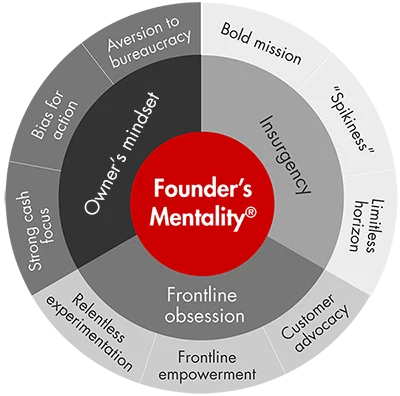
1. Insurgency with a Mission
Founders are insurgents. They don’t start a business to maintain the status quo – they start to disrupt it. They have a bold mission, and it becomes personal.
Service Culture Implication: When teams adopt this insurgent mindset, service becomes more than a transaction. It becomes a purpose. Serving others well is not just a job – it’s a daily act of rebellion against mediocrity.
Application: Clarify the mission behind the service. Invite frontline teams to own that mission. Talk about the why as much as the what.
2. Frontline Obsession
Founders obsess over the people on the front lines. Not because they’re sentimental, but because they know that’s where the truth lives. Customers don’t interact with strategy decks or internal dashboards – they interact with humans.
Service Culture Implication: A culture that listens to and empowers its frontline teams is one that will keep evolving, improving, and surprising its customers.
Application: Prioritise the voice of the frontline. Equip them. Celebrate their insights. Let their observations shape how service is delivered.
3. An Owner’s Mindset
Founders act like owners because they are owners. They’re not waiting for someone else to fix it. They care about outcomes. They look after the brand like it’s their name on the door.
Service Culture Implication: When every team member acts like an owner, service levels rise. They notice the little things. They follow through. They make decisions that protect the customer experience.
Application: Create environments where autonomy is possible. Share the bigger picture. Recognise and reward behaviour that reflects ownership.
4. Simplicity in Systems
Growth can breed complexity, which often strangles service. Founders push back on this. They simplify to scale. Simplicity keeps the mission clear and the execution agile.
Service Culture Implication: The best service cultures aren’t built on pages of SOPs – they’re built on clarity. When everyone understands the few things that matter most, excellence becomes repeatable.
Application: Streamline procedures. Clarify values. Make it easy for teams to do the right thing, not just the compliant thing.
5. Spikiness Over Sameness
Founders don’t aim to be average at everything. They build around a spiky capability – something they do exceptionally well. It becomes their signature.
Service Culture Implication: The same applies in service. What’s the signature move? What’s the experience that no one else can replicate?
Application: Identify and develop the team’s spikiest capabilities. Lean into what sets the organisation apart. Don’t dilute the distinctiveness.
Why This Matters for BIAMIC
The Founder’s Mentality doesn’t belong only to entrepreneurs. It’s a mindset that can be revived in any organisation, at any level. In BIAMIC’s coaching, workshops, and consulting, these principles are deeply embedded – helping leaders and teams reconnect to purpose, reclaim simplicity, and re-energise service.
Service excellence isn’t built by systems alone. It’s built by people who believe in what they’re doing and act like it matters. Reignite the mission. Obsess over the frontline. Think like an owner. And build something worthy of loyalty.
Make a booking to chat about how this could best serve you.